A (very) brief history of foods' ethnic "authenticity"
"Meals make the society, hold the fabric together in lots of ways that were charming and interesting and intoxicating to me. The perfect meal, or the best meals, occur in a context that frequently has very little to do with the food itself." – Anthony Bourdain
What is “authentic”? By definition, in practice, in theory? What a short but loaded question. Authenticity usually means that the origins of something are “true” or genuine. But when it comes to culture, what is "true" when everyone has their own perspective and worldview? Does adhering to one culture make others “false” – clearly not! As with many aspects of cultures, there is no capital-T Truth. But then how can we determine that something is authentic? Perhaps we can’t. Looking to history we can understand that humans have been itinerant since before we were Homo sapiens; traversing, exploring, discovering what fit for our survival.
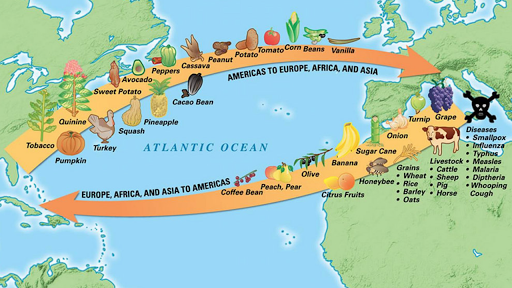
Figure 1: The Columbian Exchange (Khan Academy, 2016)
Look back to the 15th and 16th centuries, namely to the Columbian Exchange. Christopher Columbus’ name is thrown around a lot in the pseudo-discovery of the New World, what is now North and South America. But his name also lends itself to the transfer of goods, food, people, culture, animals, and diseases that were transported between Africa, Europe and the Americas. As mentioned in the previous post, Figure 1 mostly focuses on the larger-scale exchanges of food products that occurred: turkey, pumpkin, cocoa beans from the New World, and grapes, pears and so much livestock and grains from the Old World. These exchanges of crops, livestock and disease drastically changed the futures of both regions. The New World was now susceptible to colonization, pestilence and assimilation from Europeans, and Europe would see its industrial revolutions bolstered by their newfound crops (Kiple, 2007, p. 214). Think of a dish, basically any dish from anywhere in the world currently, and it likely has some ingredient that was not “native” to where the dish was created. Sure, it may be plentifully grown there now, but is that craft Guatemalan coffee that revives you every morning really “authentic”? Or more importantly when can things be considered “authentic” in the local or global sphere? How many years or generations does it take for something to become accepted as “the way things are”? When did Budae Jjigae become a comforting, traditional Korean dish? Authenticity is not objective or inherent, but is formed and molded through time, what works, and what is taught to us.
As nations began to emerge post-Middle Ages so too did national cuisines. Groups wanted to set themselves apart from those they interacted with, even becoming nicknamed what they ate: French favouritism to frog legs had them labelled as “frogs”, the Germans became “krauts” and the English were “limeys” (Kiple, 2007, p. 215). But to many such foodways were not necessarily choices made, but specific options available regionally. Authenticity-of-food was formed throughout this time, yet its not something we can put in a box, to be sealed off from changes and evolution (similar to culture). While many may believe there is a standard way to create food dishes this does not include the practicality of shifting tastes, products and crops. Arjun Appadurai reminds us that “all cuisines have a history: tastes shift, regional distinctions go in and out of focus, new techniques and technologies appear” (Ku, 2014, p. 4). It’s weird to see a nacho donut... But more importantly, if it works and is passed down, and then adopted by the larger community, who is anyone to say it’s not allowed?
These changes have been happening for longer than you or I have had the capacity to think through these things and make decisions. Colonization has long influenced food, such as British domination of Egypt and India brought Indian spices to the north-west, colonization and influence of the Dutch East Indies created the risjistafel (rice table) of the Netherlands, and Portuguese colonies of Angola, Mozambique, Brazil and Goa changed how both those in Europe and those working in the fields od the colonies would cook and eat (Kiple, 2007 p. 218). But now that we seem to have the privilege and option to create so-called boundaries, we seem to be doing it left, right and center. Meals are built upon histories, knowledges, tools and technologies, beliefs and availability. The context of what is cooking, what appears on your plate or scintillates your taste buds is not just the fruits, vegetables, meats, spices you put into it. It is the collection of so much culture in one dish. It is more than the sum of its parts. It's not all from one place, despite appearances, and that’s the whole point!
So, perhaps, certificates of “authenticity” are best saved for Antiques Roadshow.
References
Khan Academy. (2016). Columbian Exchange [photograph]. Retrieved from https://cdn.kastatic.org/googleusercontent/8PQUPZA4eYxK5Xve6kqfs4z2kSbDwu9EwlH2xpaUgxy4i7wPXk5avu-GmZdpJAdbm0XAcUSj4Hd6g0jMiCAkiBM
Kiple, K. F. (2007). A moveable feast: Ten millennia of food globalization. New York, NY: Cambridge University Press.
Ku, R. J.-S. (2014). Dubious Gastronomy: The Cultural Politics of Eating Asian in the USA. Honolulu: University of Hawaii Press. Retrieved from http://ezproxy.macewan.ca/login?url=http://search.ebscohost.com/login.aspx?direct=true&db=e000xna&AN=732403&site=ehost-live&scope=site
What is “authentic”? By definition, in practice, in theory? What a short but loaded question. Authenticity usually means that the origins of something are “true” or genuine. But when it comes to culture, what is "true" when everyone has their own perspective and worldview? Does adhering to one culture make others “false” – clearly not! As with many aspects of cultures, there is no capital-T Truth. But then how can we determine that something is authentic? Perhaps we can’t. Looking to history we can understand that humans have been itinerant since before we were Homo sapiens; traversing, exploring, discovering what fit for our survival.
Look back to the 15th and 16th centuries, namely to the Columbian Exchange. Christopher Columbus’ name is thrown around a lot in the pseudo-discovery of the New World, what is now North and South America. But his name also lends itself to the transfer of goods, food, people, culture, animals, and diseases that were transported between Africa, Europe and the Americas. As mentioned in the previous post, Figure 1 mostly focuses on the larger-scale exchanges of food products that occurred: turkey, pumpkin, cocoa beans from the New World, and grapes, pears and so much livestock and grains from the Old World. These exchanges of crops, livestock and disease drastically changed the futures of both regions. The New World was now susceptible to colonization, pestilence and assimilation from Europeans, and Europe would see its industrial revolutions bolstered by their newfound crops (Kiple, 2007, p. 214). Think of a dish, basically any dish from anywhere in the world currently, and it likely has some ingredient that was not “native” to where the dish was created. Sure, it may be plentifully grown there now, but is that craft Guatemalan coffee that revives you every morning really “authentic”? Or more importantly when can things be considered “authentic” in the local or global sphere? How many years or generations does it take for something to become accepted as “the way things are”? When did Budae Jjigae become a comforting, traditional Korean dish? Authenticity is not objective or inherent, but is formed and molded through time, what works, and what is taught to us.
As nations began to emerge post-Middle Ages so too did national cuisines. Groups wanted to set themselves apart from those they interacted with, even becoming nicknamed what they ate: French favouritism to frog legs had them labelled as “frogs”, the Germans became “krauts” and the English were “limeys” (Kiple, 2007, p. 215). But to many such foodways were not necessarily choices made, but specific options available regionally. Authenticity-of-food was formed throughout this time, yet its not something we can put in a box, to be sealed off from changes and evolution (similar to culture). While many may believe there is a standard way to create food dishes this does not include the practicality of shifting tastes, products and crops. Arjun Appadurai reminds us that “all cuisines have a history: tastes shift, regional distinctions go in and out of focus, new techniques and technologies appear” (Ku, 2014, p. 4). It’s weird to see a nacho donut... But more importantly, if it works and is passed down, and then adopted by the larger community, who is anyone to say it’s not allowed?
These changes have been happening for longer than you or I have had the capacity to think through these things and make decisions. Colonization has long influenced food, such as British domination of Egypt and India brought Indian spices to the north-west, colonization and influence of the Dutch East Indies created the risjistafel (rice table) of the Netherlands, and Portuguese colonies of Angola, Mozambique, Brazil and Goa changed how both those in Europe and those working in the fields od the colonies would cook and eat (Kiple, 2007 p. 218). But now that we seem to have the privilege and option to create so-called boundaries, we seem to be doing it left, right and center. Meals are built upon histories, knowledges, tools and technologies, beliefs and availability. The context of what is cooking, what appears on your plate or scintillates your taste buds is not just the fruits, vegetables, meats, spices you put into it. It is the collection of so much culture in one dish. It is more than the sum of its parts. It's not all from one place, despite appearances, and that’s the whole point!
So, perhaps, certificates of “authenticity” are best saved for Antiques Roadshow.
______________________________________
Khan Academy. (2016). Columbian Exchange [photograph]. Retrieved from https://cdn.kastatic.org/googleusercontent/8PQUPZA4eYxK5Xve6kqfs4z2kSbDwu9EwlH2xpaUgxy4i7wPXk5avu-GmZdpJAdbm0XAcUSj4Hd6g0jMiCAkiBM
Kiple, K. F. (2007). A moveable feast: Ten millennia of food globalization. New York, NY: Cambridge University Press.
Ku, R. J.-S. (2014). Dubious Gastronomy: The Cultural Politics of Eating Asian in the USA. Honolulu: University of Hawaii Press. Retrieved from http://ezproxy.macewan.ca/login?url=http://search.ebscohost.com/login.aspx?direct=true&db=e000xna&AN=732403&site=ehost-live&scope=site
Comments
Post a Comment